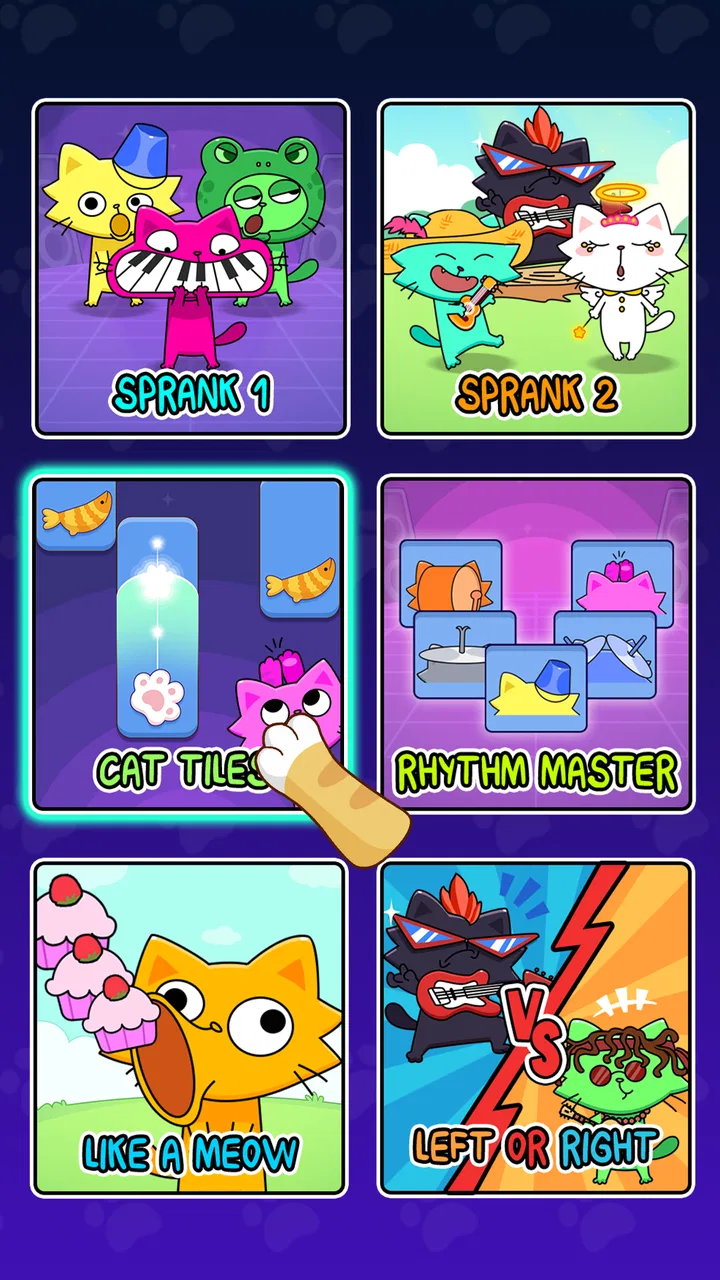
Cat Music Beat Box
- 3.4
- Rating
- 100.00K
- Installs
- Free
- Price

 Analysis by App-foxy
I tried Cat Music Beat Box expecting a small, playful music game built around its unusual central idea: mixing cat sounds with beats. That is exactly the appeal here. Developed by WingsMob, it sits in the music-game space rather than trying to be a full music production tool, and its simple concept makes it easy to understand within moments. You combine feline sounds and rhythmic elements to create something that feels more like a toy for musical experimentation than a serious beat-making workstation.
That distinction matters. If you want a polished rhythm challenge with demanding timing, a deep song library, or the controls of a conventional beat editor, this is probably not where I would send you first. If you enjoy odd sound combinations, casual interaction, and games that invite you to experiment without demanding a long commitment, it has a much clearer purpose. I found the best way to approach it was as a quick creative diversion rather than as a replacement for a music app.
What Cat Music Beat Box feels like in everyday use
The first thing that makes the game memorable is its sound-based personality. The cat theme is not just decoration around an ordinary music title; it is the reason to open the game in the first place. Instead of asking me to learn complicated musical theory, it encourages a more immediate question: what happens when these playful cat noises are placed against a beat?
You May Also Like

 AccuWeather: Weather Radar
AccuWeather Review: A Quick, Clear Forecast for Everyday Decisions
For everyday plans, the best forecast is the one you can understand quickly. AccuWeather makes rain timing, radar, and local conditions easy to act on, with a few trade-offs.

 Hill Climb Racing
Why Hill Climb Racing Still Turns Crashes Into One More Run
A tiny car, a bumpy hill and one more upgrade: Hill Climb Racing keeps resurfacing because its simple chaos makes every near-miss feel personal.

 AliExpress - Shopping App
AliExpress Makes Global Shopping Feel Personal, but Shoppers Bear the Risk
AliExpress turns a global marketplace into a pocket-sized discovery engine. Its reach is useful, its shopping loop compelling, and its trade-offs easy to miss.

 Lords Mobile: Kingdom Wars
Lords Mobile Is a Kingdom-Building Routine, Not a Quick Match
A case-by-case verdict on the building, battles, device demands, and social commitments that make Lords Mobile rewarding for some players and exhausting for others.

 PDF Scanner app - TapScanner
TapScanner Makes Paperwork Easier to Capture, Check, and Share
TapScanner makes scanning with a phone feel less like a rescue operation and more like a dependable step in getting work done. Its capture tools are useful, though not flawless.

 Block Blast!
 Shows How Much a Puzzle Game Can Leave Out
A quiet grid game shows why puzzle players increasingly value instant clarity, repeatable skill and low-pressure play—and where the genre still needs to catch up.
More From Our News Desk
View All News


That makes it approachable for people who may normally avoid music games. You do not need to know how to read music, understand chord progressions, or recognize technical production terms before trying it. The experience is built around listening, tapping, combining, and deciding whether the result sounds amusing or satisfying. I could imagine handing it to someone who rarely plays games and seeing them understand the basic attraction quickly.
At the same time, the simplicity creates a natural limit. A game based on a compact idea can be enjoyable for short sessions, but it may not provide enough depth for someone who wants a long-term creative project. My recommendation is to treat each session as a small sound experiment. Trying to force it into the role of a complete digital audio workstation would make its limitations much more obvious.
Free access changes the decision
The game is free, which makes the initial decision pleasantly straightforward. You can try the cat-and-beat concept without paying an entry fee, so there is no need to decide whether a premium music tool is worth its cost before understanding how the interaction feels. From a value perspective, that is its strongest practical advantage: the barrier to experimentation is low.
Free does not automatically mean that every player will find lasting value. For me, the real question is whether the novelty remains entertaining after the first few sessions. Someone looking for a quick distraction can get a fair reason to install it, while a musician searching for precise control may find that free access is less important than the depth and flexibility offered by a different kind of app.
I also appreciate that the free price makes it suitable for sharing casually with family members or friends, provided the Teen content rating fits the person using the device. It works well as a “try this strange music game” recommendation rather than as a purchase decision requiring careful financial comparison. The price removes the risk, but it does not remove the need to match the game to the right expectations.
Where the value actually comes from
The value is mainly in the combination of novelty and immediacy. Many music games use familiar instruments, dance tracks, or traditional rhythm mechanics. This one has a more specific identity: it turns cat sounds into the material for beat-based play. That unusual focus gives it a reason to exist beyond being another generic tapping game.
I found three useful ways to approach it. First, it works as a short break when I want something interactive but do not want to commit to a story, a long level, or a competitive match. Second, it can act as a playful introduction to layering sounds, especially for younger or less experienced users who respond better to animals and humor than to formal music terminology. Third, it is a conversation starter: the unusual audio concept makes it more memorable than an anonymous rhythm title.
A less obvious benefit is that it can encourage active listening. When several sounds are mixed, the player has to notice whether they fit together or become distracting. That is not the same as learning music production, but it can make someone more aware of rhythm, repetition, and sonic contrast. I would not present it as an educational course, yet it can still provide a gentle, informal way to explore those ideas.
Another practical strength is its suitability for very short sessions. I would use it while waiting for an appointment, taking a break from work, or showing a friend something unusual. It does not need to become the main game on a phone to justify its place there. For this kind of casual use, a focused concept can be more valuable than a large feature list.
A realistic daily scenario
Imagine a parent has a few quiet minutes before leaving the house and wants to keep a child occupied without opening a complicated game. Cat Music Beat Box can fit that moment because its theme is immediately readable and its musical premise is playful. The child can explore the sounds, while the adult can join in by suggesting different combinations or asking which rhythm feels better.
Another scenario is a group of friends looking for a quick activity that does not require everyone to understand the same game rules. One person can start experimenting, another can react to the sound, and the group can decide which mix is the funniest or most enjoyable. That social value comes from the game’s personality rather than from a large multiplayer system, so I would keep the expectation modest: it is a shared novelty, not a full party platform.
For solo use, I would set a small goal before opening it. Try to make a combination that sounds calm, energetic, or deliberately silly. Without a personal challenge like that, the experience may feel brief. With one, the same limited set of interactions can become more engaging because you are listening for a result instead of tapping without direction.
Tips for getting more from the sound mixing
My first tip is to change one element at a time. If you alter everything immediately, it becomes difficult to tell which cat sound or beat improved the mix. Start with a simple rhythm, add one sound, listen for a moment, and then make another change. This turns the game from random tapping into a small process of comparison.
My second tip is to use headphones when the surroundings are quiet enough. The game’s appeal depends on hearing how the sounds sit together, and speakers in a busy room can make every combination seem flatter or more chaotic than it really is. Headphones will not transform it into professional production software, but they can make the central experiment easier to judge.
Third, do not assume that the busiest arrangement is the best one. The funniest or most satisfying result may come from leaving space between sounds. I found that treating silence and repetition as part of the experiment makes the game less disposable. This is a small but useful habit for anyone who wants to hear the difference between adding more and adding something that actually helps.
Finally, use the game as a prompt rather than a destination. After making a combination you like, ask what made it work: was it the contrast between the cat sound and the beat, the timing, or simply the surprise? That question adds a little more thought to a lightweight game without pretending that it offers the editing precision of a dedicated music application.
What may frustrate experienced players
The same simplicity that makes the game approachable may frustrate players who want control. A dedicated beat-making app is the better choice if you need detailed sequencing, recording, editing, exporting, or a broad library of instruments. A conventional rhythm game is likely a better fit if your main goal is accuracy, score chasing, increasingly difficult stages, or a strong sense of progression.
Cat Music Beat Box also depends heavily on whether the cat-sound concept appeals to you. If you find novelty audio irritating rather than entertaining, the central idea will not become more convincing through repetition. This is not a neutral music sandbox that happens to include cats; the theme is the experience. I would skip it if you already know that this style of playful sound design is not for you.
There is also a trade-off between accessibility and depth. Because the premise is easy to grasp, the game can feel welcoming from the start. But players who enjoy mastering complex systems may reach the edge of its appeal sooner than casual users. That is not necessarily a flaw in a free game, although it does mean that the expected playtime should be realistic.
The average rating is 3.4 from around 325 ratings, with about 10 written reviews, which suggests a mixed reception rather than universal enthusiasm. I would read that as a useful warning against expecting a polished, endlessly replayable music platform. It does not make the game unworthy of trying; it simply reinforces my view that the right audience is curious casual players, not everyone who enjoys music games.
Device and audience considerations
The game supports devices running Android 7.1 or later, so people using older phones should check compatibility before planning to install it. Its current version is 1.0.8, and it was released on December 13, 2024. Those details are worth noting because a lightweight concept can still be inconvenient if the device cannot run it or if the player expects a much older, extensively expanded title.
The Teen content rating is another point parents should consider. The cat-and-music premise sounds broadly playful, but the formal age guidance should still take priority when deciding whether it belongs on a child’s device. I would not rely only on the cute theme to make that decision. Check the rating alongside the age and habits of the person who will actually use it.
With over 100 thousand installs, it has reached a meaningful casual audience without becoming something I would describe as a universal hit. That level of adoption makes it easier to see the game as an established experiment rather than an entirely unknown download, but it should not be treated as proof that it will suit every player. The concept remains more important than the install count.
Who will get the best value
I would recommend it to people who enjoy quirky mobile games, cat-themed entertainment, and simple music experimentation. It is especially suitable for someone who wants a free title that can be understood quickly and revisited in short bursts. It may also appeal to families or friends looking for a harmless conversation piece, as long as the Teen rating is appropriate for everyone involved.
It is less suitable for aspiring producers, DJs, and musicians who need reliable technical tools. If your goal is to build a full track, control every layer, save detailed arrangements, or work with a serious production workflow, choose a dedicated music app instead. Likewise, competitive rhythm-game fans should look for a title designed around timing tests and progression rather than sound-based novelty.
I would also skip it if you need a game with a strong narrative, a large progression system, or a clear long-term achievement path. Its appeal is concentrated in the act of mixing cat sounds and beats. That can be enough for a few enjoyable moments, but it is not the same kind of value as a game that offers dozens of goals or a deep campaign.
My final recommendation
My verdict is a cautious yes, with the right expectations. Because Cat Music Beat Box is free, trying it is an easy way to find out whether its unusual audio concept makes you smile or becomes repetitive. I would recommend it as a small, playful music game for casual sessions, especially to people who like experimental sound combinations and do not need professional controls.
I would not recommend choosing it over a dedicated music-making app or a demanding rhythm game. Those alternatives are better when precision, depth, progression, or production features matter more than personality. The game’s value is not in replacing them; it is in offering a very specific kind of lightweight amusement that few conventional music tools would attempt.
For me, the deciding question is simple: do you want to make serious music, or do you want to play with the idea of music using cat sounds? If the second answer sounds entertaining, the free download is worth a try. If the first answer is closer to what you need, save your time and choose a tool built for that purpose. Its best quality is its focused weirdness, and that is also the reason it will not be right for everyone.
FAQs for Cat Music Beat Box
01What is Cat Music Beat Box and how does it work?
Cat Music Beat Box is an entertaining rhythm-based game where players compose music using a variety of cat sounds. Users tap on different cat icons to create melodies and beats. The app features multiple sound packs and levels, allowing users to explore their creativity while enjoying adorable cat animations.
02Is Cat Music Beat Box free to download and play?
Cat Music Beat Box is free to download with basic features available for all users. However, it offers in-app purchases for premium sound packs and additional content. These optional purchases enhance the gaming experience but are not necessary to enjoy the core features of the app.
03What are the device requirements for Cat Music Beat Box?
Cat Music Beat Box requires iOS 11.0 or later for Apple devices and Android 5.0 or higher for Android devices. It is optimized for both smartphones and tablets, ensuring smooth performance across various devices. Ensure you have sufficient storage space for downloads and updates.
04Does Cat Music Beat Box offer multiplayer or social features?
Currently, Cat Music Beat Box focuses on single-player gameplay, allowing users to enjoy creating music solo. However, it includes options for sharing your compositions with friends via social media or messaging apps, enabling you to showcase your creativity and get feedback from others.
05Are there any parental controls or age restrictions for Cat Music Beat Box?
Cat Music Beat Box is designed to be family-friendly and is suitable for players of all ages. However, with in-app purchases available, it's advisable for parents to set up appropriate purchase restrictions to prevent unintended transactions by younger children. The game itself does not contain inappropriate content.
Pros
- Engaging rhythm-based gameplay.
- Vibrant and colorful graphics.
- Wide variety of music tracks.
- Intuitive controls for easy play.
- Regular updates with new content.
Cons
- Occasional in-game ads.
- Limited offline play options.
- Some tracks require in-app purchases.
- May drain battery quickly.
- Requires internet for full features.

Cat Music Beat Box
Gallery